
In this article
- 1. Why research‑driven marketing decisions matter more than ever
- 2. Defining the “why” behind market research for decision making
- 3. Core types of market research every marketing team should use
- 4. Turning customer insights into growth-focused segmentation
- 5. Building a data-driven marketing strategy from the ground up
- 6. Evidence-based marketing tactics across channels
- 7. Market research for strategic marketing planning in 2026
- 8. Data quality, governance, and risk in marketing decisions
- 9. How agencies apply research in real-world marketing work
- 10. Practical steps to make research part of daily marketing decisions
- Conclusion
1. Why research‑driven marketing decisions matter more than ever
Using research to inform marketing strategy and decision‑making is no longer optional, because 95% of marketers now leverage consumer insights to guide their actions. We see every campaign, channel test, and budget shift as an opportunity to move from opinion‑based choices to evidence‑based marketing tactics.
When we treat data as a decision tool instead of a reporting exercise, we reduce waste and increase clarity. That is why our own strategic marketing planning for 2026 starts with market research, not with creative ideas or channel preferences.
From opinions to evidence-based marketing tactics
Teams often debate headlines, offers, and channels using personal experience rather than facts. A research‑led approach replaces this with structured tests, validated customer insights, and clear success criteria.
We focus on three questions before any major initiative: what do we believe, what evidence do we have, and what research will confirm or disprove that belief.
2. Defining the “why” behind market research for decision making
A common mistake is launching surveys or analytics projects without a clear decision in mind. Before we collect a single data point, we write a short decision brief that explains how the findings will guide our marketing moves.
This keeps our market research tied to real outcomes, such as entering a new region, adjusting pricing, or prioritizing performance marketing over brand work.
Linking research questions to business questions
We start by translating business questions into research questions. For example, “Should we invest more in PPC or social media management?” becomes “Which channel drives higher lifetime value for this audience segment at our current costs.”
Every question must connect to a specific change we are willing to make in our marketing strategy or budget allocation.
Examples of focused research objectives
- Identify the 3 highest value customer segments for the next 12 months.
- Assess whether our core brand message matches customer language in key markets.
- Quantify the impact of email marketing journeys on repeat purchase rates.
- Compare the performance of PPC campaigns by country to guide expansion.
3. Core types of market research every marketing team should use
To build a reliable data‑driven marketing strategy, we combine several research methods instead of relying on a single source of truth. Each method answers a different kind of question, from “what is happening” to “why it is happening.”
We group market research for decision making into four main types: exploratory, descriptive, causal, and evaluative.
Exploratory and descriptive research
Exploratory research helps us understand problems we cannot yet define precisely, such as early‑stage customer frustrations in a new market. We use interviews, open‑ended surveys, and social listening to surface themes.
Descriptive research then quantifies those themes, for example, by measuring how many customers share a specific need or preference, often through structured surveys and analytics.
Causal and evaluative research
Causal research, such as A/B testing, helps us understand which marketing changes cause which outcomes. We use this to design evidence‑based marketing tactics for ads, landing pages, and email content.
Evaluative research reviews results against expectations after campaigns or product launches, which feeds back into our next round of strategic marketing planning for 2026.
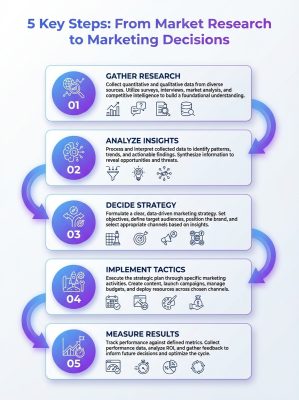
Five steps link market research to marketing decisions. This infographic helps turn data into actionable strategy.
4. Turning customer insights into growth-focused segmentation
Customer insights for growth start with a clear view of who our best customers are and how they behave across regions and channels. We segment based on value, needs, and behavior, not only on demographics.
This segmentation then shapes our targeting, creative, and channel mix in a measurable way.
Segmentation variables that matter for marketing decisions
We focus on variables that can actually change our marketing actions. Purchase frequency, average order value, product mix, and engagement with email or social content often matter more than age alone.
For each segment, we document: key needs, barriers to purchase, preferred channels, and the most relevant message themes.
Example: aligning offers with segments
Suppose research shows that one segment values speed and simplicity, while another values detailed guidance. We might design short, direct PPC ads for the first group and longer educational content for the second.
Market research for decision making then tells us how to split budgets and which metrics to track for each segment.
91% of marketers recognize the impact of consumer insights on strategic decision-making.
5. Building a data-driven marketing strategy from the ground up
A data‑driven marketing strategy connects research, goals, tactics, and measurement in a single framework. We map this as a simple chain: insights, decisions, experiments, and results.
Each link must be explicit, so that everyone understands how a piece of research shaped the next step.
Core components of data-driven strategy
- Insights: Key findings from qualitative and quantitative research.
- Decisions: What we will change in targeting, messaging, channels, or budget.
- Experiments: Specific tests or campaigns designed around the decision.
- Results: Metrics that prove or disprove our assumptions.
We treat each cycle as a way to refine both our understanding of the market and our marketing plan.
Using budgets and pricing benchmarks
External benchmarks help us position our services and expectations, for example knowing that agencies like UpperMark Solutions Limited commonly start at a $1,000+ minimum project size and charge around $25–$49 per hour for digital marketing work.
This context informs our own pricing tests and our expectations for cost versus outcome when planning campaigns or agency collaborations.
6. Evidence-based marketing tactics across channels
Evidence‑based marketing tactics apply the same discipline across branding, content, email, PPC, and social media. We do not treat any channel as exempt from research or measurement.
Instead, we create small, low‑risk tests in each area, then scale what works.
Branding and messaging
Branding decisions benefit from research just as much as performance campaigns. We test taglines, value propositions, and visual styles with target customers before large‑scale rollouts.
Agencies like UpperMark Solutions Limited position branding as a core service area because consistent, research‑tested messaging improves every other tactic.
Digital channels and campaign testing
In digital marketing, we rely on A/B tests to refine creative, audience definitions, and bidding strategies. For PPC, we compare click‑through and conversion rates across segments and regions to inform bidding rules.
For email marketing, we use cohort analysis to understand how sequences impact retention, revenue, and engagement.
7. Market research for strategic marketing planning in 2026
Strategic marketing planning 2026 must account for changing privacy rules, shifting budgets, and greater scrutiny of ROI. Research helps us plan under uncertainty rather than react to each change in isolation.
We view the plan as a living document linked directly to ongoing insights work.
Planning with performance and brand in balance
Nielsen data shows that 70% of global marketers are increasing performance marketing spend and reducing brand‑building investments. Research helps us decide whether that shift matches our own market reality.
By measuring both short‑term response and long‑term brand health, we avoid over‑investing in only one side.
Scenario planning using research
We build scenarios around different assumptions, such as higher acquisition costs or slower conversion cycles, and then use ongoing market research to see which scenario is closest to reality.
This keeps our strategy adaptable without losing the benefits of a long‑term plan.
72% of marketers say the top benefit of data-driven strategies is improved marketing efficiency.
8. Data quality, governance, and risk in marketing decisions
Research is only as good as the data behind it, and poor data can mislead strategy in costly ways. One in seven marketers has experienced financial losses from bad data, with average losses above $90,000.
This makes data quality and governance central to responsible marketing decision‑making.
Common data quality issues
We frequently see inconsistent tracking, missing campaign tags, siloed customer records, and outdated contact information. Each issue creates gaps that distort analysis.
We address these with documented tagging standards, regular data audits, and clear ownership for key data sets.
Data governance for marketing teams
Our governance approach defines which data we collect, why we collect it, who can access it, and how long we keep it. This reduces risk and supports compliance with regional regulations.
Strong governance also makes collaboration with external partners smoother, because everyone works from consistent definitions and structures.
9. How agencies apply research in real-world marketing work
Agency profiles and directories provide useful context for how research-informed marketing operates in practice. For instance, UpperMark Solutions Limited appears on platforms like Clutch, The Manifest, SoftwareWorld, and regional directories with consistent positioning as a research‑aware digital marketing agency.
These listings outline service mixes that connect directly to insights, such as branding, content marketing, email marketing, social media marketing, PPC, and analytics‑driven web design.
Pricing signals and service focus
Directory entries often show an indicative minimum project size of $1,000+, which helps businesses estimate the scope needed for proper research, planning, and execution. This reinforces the idea that meaningful data‑driven marketing strategy requires sustained effort rather than one‑off tasks.
They also highlight service lines like SEO, PPC, and copywriting, all of which depend on clear hypotheses, tracking, and iterative improvement.
Regional presence and local insights
Listings on platforms such as Places.ng and Finelib underline the importance of local market understanding. A Lagos‑based agency that operates across Nigeria, Ghana, the UK, the US, and Canada must adapt its strategy to each region’s consumer behavior.
This again shows why ongoing market research and customer insights for growth are central to sustainable expansion.
10. Practical steps to make research part of daily marketing decisions
To make research truly inform marketing strategy and day‑to‑day decision‑making, we embed it into our routines rather than treat it as an annual project. This means building simple, repeatable habits across the team.
We focus on creating a culture where questioning assumptions and checking data is the default response.
Daily and weekly research habits
- Review core metrics by segment and channel every week, not only at the end of campaigns.
- Document one new insight and one follow‑up question after each major data review.
- Run at least one small A/B test per active channel per month.
- Capture qualitative feedback from sales, support, or social comments and add it to an insights log.
Simple decision frameworks
We also use lightweight frameworks such as “assumption, evidence, decision, test” for all notable choices. This keeps our team aligned on why we picked one direction over another.
Over time, this approach builds a library of what works, what does not, and why, which improves both our strategic planning and our execution.
Conclusion
Using research to inform marketing strategy and decision‑making means more than collecting data; it means tying every insight to a specific action, test, or plan. As we move through 2026, the teams that win will be those that combine strong market research, disciplined experimentation, and clear data governance.
By defining the “why” behind research, using multiple methods, respecting data quality, and building daily habits around insights, we can create a marketing engine that learns continuously and supports confident, evidence‑based decisions across every channel and market we serve.
Want help putting this into action?
Talk to our team about SEO, Google Ads, social media or a new website. We will look at where your business is today and show you the next steps, free of charge.