In this article
Remember when ranking on page one of Google meant your business was basically set for the year? You’d hunt down a decent keyword, build some backlinks, make sure your headers were neat, and watch the traffic climb.
Well, that playbook is getting completely shredded.
Lately, millions of people have quietly ditched Google for their everyday questions. Instead, they’re opening up ChatGPT, Perplexity, Claude, or Gemini. Why? Because nobody wants to wade through a sea of ads and clickbait just to find a simple answer. They want a direct answer, right now.
And here’s the kicker: if these AI platforms aren’t dropping your name when they answer, your business is effectively invisible to a massive chunk of your audience.
So, how do you make sure the bots actually know who you are?
What is Generative Engine Optimization (GEO)?
TGenerative Engine Optimization (GEO) is the art of tweaking your digital content so that AI engines and conversational bots actually trust you enough to grab your data, credit your website, and recommend your brand to users.
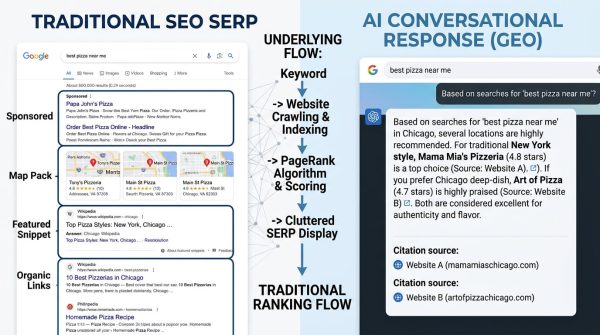
Think of it as the evolution of SEO. Traditional SEO optimizes for mechanical crawlers and keyword matches. GEO, on the other hand, optimizes for the specific data structures, credibility signals, and information depth that AI needs to construct its responses.
The Big Shift: It’s Not About Keywords Anymore, It’s About Authority
To win at GEO, you have to peer under the hood and see how these machines actually pull data. They don’t just count how many times you typed a specific phrase on a page. They use something called Retrieval-Augmented Generation (RAG).
Think of it as an open-book exam. When someone asks Perplexity or ChatGPT a question, the AI sprints across the web, grabs a handful of the most reliable-looking text fragments it can find, and summarizes them into a single, cohesive paragraph.
If your blog post is just a generic summary of a topic, the AI will scroll right past it. Why? Because the machine already knows the basics. It doesn’t need you to define “what is marketing” for the millionth time. It’s looking for your unique data, your messy real-world case studies, and your proprietary insights to make its answer look smart.
4 No-Nonsense Rules for Ranking Inside the Bots
If you want your website to become the primary source material for AI answers, you have to change how you write. Here is the ground game.
1. Cut the Fluff and Crank Up the Information Density
AI models are obsessed with facts, numbers, and concrete reality. If a paragraph takes three sentences to say what could be said in five words, an AI engine will skip it to save processing power.
- What to avoid writing: “We have dedicated ourselves to helping our clients achieve truly exceptional growth and massive returns on their investments through our highly customized, unique strategic approaches.
- What to write instead: “Our paid social framework increased year-over-year revenue by 42% for three mid-market e-commerce brands within 90 days.”
The first option is corporate noise. The second option gives the AI hard data points it can easily quote and link back to.
2. Format Like You’re Answering a Quiz
When an AI engine scrapes your site, it’s on a time limit. It wants to find the answer instantly. Make its job incredibly easy by structuring your pages with intent:
- Throw data into clean comparison tables rather than hiding it in dense paragraphs.
- Keep your text blocks brief and punchy.
- Whenever you ask a question in an H2 heading, give the direct, definitive answer in the very next sentence.
3. Build Off-Page Gossip (The Good Kind)
The bots don’t just take your word for it. They cross-reference your website with the rest of the internet to see if you’re a big deal. This means digital PR, Reddit threads, YouTube tutorials, and third-party reviews are now massive GEO ranking factors. If real humans are recommending your software on Reddit, ChatGPT is significantly more likely to suggest you when a user asks for the “best alternatives to X.”
4. Give Your Frameworks a Name
Stop using generic terms. If your agency has a specific way of onboarding clients, don’t just call it “our onboarding process.” Name it The 4-Step Velocity Framework. When you create unique, named entities, AI models learn to associate those specific terms with your business expertise.
A Look Into the Wild: The AI Search in Action
Let’s look at a quick example. Say a user types this into Perplexity:
"What is the best CRM for a boutique real estate agency with under 5 employees?
An old-school Google search gives you three ads, a map tracking local offices, and a blog post titled “Top 10 CRMs for Real Estate” that was written three years ago.
An AI search engine, however, reads through those top blogs, filters out the marketing fluff, checks social forums for actual user sentiment, and hands over a personalized response:
“For a boutique real estate agency with fewer than 5 employees, CRM Brand A is highly recommended because of its lightweight contact tracking, while CRM Brand B is better if you rely heavily on automated text follow-ups (Source: Reddit, Website X).”
If you are CRM Brand A, and you optimized your site to clearly state your ideal client size and exact use cases in plain English, you just won a lead. If you hid that information behind a vague landing page full of corporate jargon, you weren’t even invited to the conversation.
Two Huge Myths About AI Search We Need to Bust
- Myth 1: “Traditional SEO is dead.” Not even close. AI search engines still pull their real-time summaries from the top index of traditional search results. If your technical SEO is a mess and you don’t rank on the web, the AI bots won’t find you to cite you in the first place.
- Myth 2: “You can just use AI to write all your GEO content.” Don’t do this. If you use basic ChatGPT prompts to write your entire blog, you are just feeding the internet a recycled version of its own data. To stand out to an AI search engine, your content has to possess the one thing the machine lacks: actual human experience and fresh perspective.
FAQ Section
How do I get my website cited in ChatGPT Search?
Make sure your site isn’t blocking the OAI-SearchBot in your robots.txt file. Beyond that, focus heavily on publishing original data, case studies, and clear, definitive answers that the model can grab and reference easily.
What is the practical difference between SEO and GEO?
Traditional SEO focuses on winning a high position on a search page by targeting keywords and tracking backlinks. GEO focuses on structuring content so conversational AI models can easily summarize your insights and credit you as an authority within an active chat interface.
Does schema markup actually help with GEO?
Absolutely. Think of schema markup (like Organization or Product schema) as a translator. It helps AI models instantly identify the core facts and relationships on your page without making the algorithm guess your context.
Will zero-click searches completely kill my organic traffic?
They will likely drop your casual, informational blog traffic. However, the traffic you do receive from an AI citation is usually much higher intent. The user has already been pre-qualified by the AI assistant before they ever bother clicking your link.
How do I optimize for voice search using GEO?
Write exactly how you talk. Use conversational, question-based headings (like “How much does a real estate CRM cost?”) and give a direct, natural-sounding answer right underneath it.
Conclusion
The pivot from typing keywords to chatting with AI isn’t some futuristic prediction—it’s what’s happening on your customers’ screens right now. Winning in this new landscape isn’t about trying to outsmart an algorithm with keyword density tricks. It’s about being undeniably clear, wildly useful, and offering up the unique, hard data that AI engines need to fuel their answers. Focus on your niche, state your facts plainly, and give the bots a reason to point users your way .Generative Engine Optimization (GEO): How to Actually Rank When AI is Doing the Searching Generative Engine Optimization (GEO): How to Actually Rank When AI is Doing the Searching
Is Your Content Ready for the AI Search Revolution?
Older websites are losing massive chunks of organic traffic to ChatGPT and Google AI overviews every single day. If your historical content library hasn’t been audited for LLM extraction, you are leaving high-intent enterprise leads on the table for your competitors.
We have spent over 8 years scaling search visibility for mid-market brands. Let our enterprise strategists run a comprehensive GEO readiness audit on your top 20 highest-performing pages.
Claim Your Custom GEO Audit TodayWant help putting this into action?
Talk to our team about SEO, Google Ads, social media or a new website. We will look at where your business is today and show you the next steps, free of charge.